
Why 100G coherent transceivers are the talk of the town and how they compare to PAM4
This article was originally published on Smartoptics.com.
Many network operators have been eagerly awaiting the arrival of 100G coherent transceivers (100G ZR) for their enhanced performance in low-cost 100G use cases. We asked our CTO Kent Lidström to shed some light on what these coherent optics can do. We’ll also go over when it makes more sense to go with coherent and when PAM4 offers cost efficiency and switch compatibility advantages.
What does 100G coherent stand for and why is it popular?
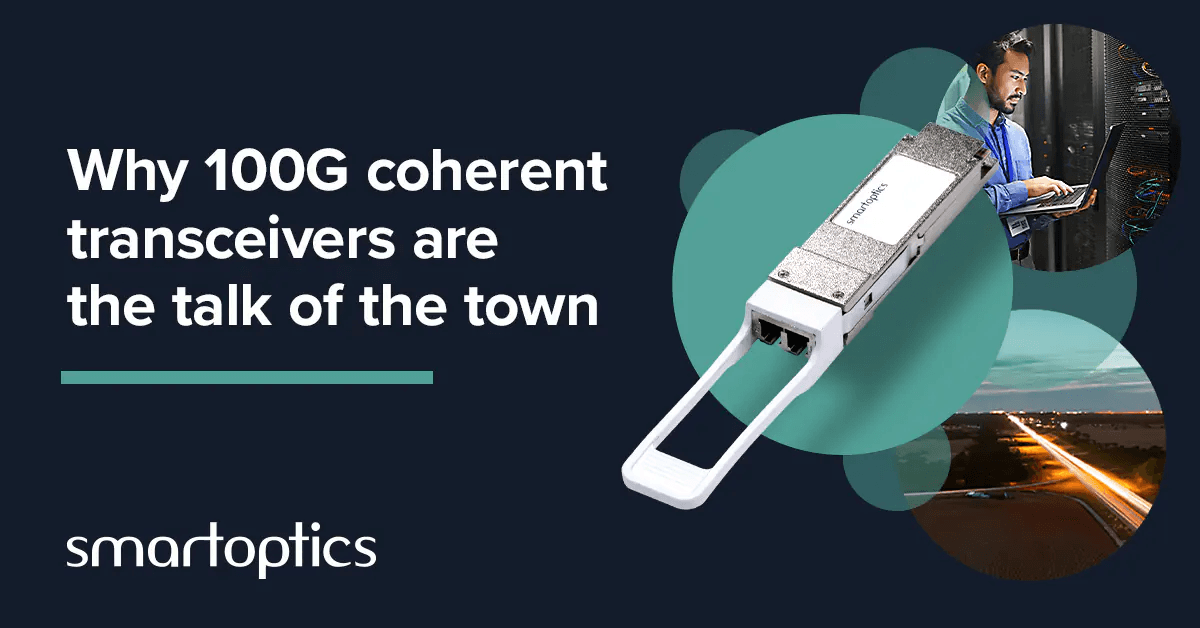
The term "100G coherent" refers broadly to transceivers that use coherent modulation techniques to enhance performance. The 100G ZR standard specifically applies these coherent technologies to the widely used QSFP28 form factor.
Kent explains why 100G coherent is popular:
“100G ZR brings the performance enhancements of 400ZR to the 100G bit rate in the compact QSFP28 form factor. This is a sweet spot in the market right now as many network operators are looking for cost-efficient 100G connectivity. This is why 100G coherent optics have become the talk of the town.”
What is the difference between 100G coherent and PAM4 optics?
PAM4 and 100G coherent are two modulation formats for 100G data transmission. 100G ZR is a more powerful modulation format that offers higher performance while PAM4 is a simpler, more cost-effective method suited for shorter distances.
Kent shares insights on when to use each of the two 100G modulation formats:
“100G coherent optics will be the top choice for applications requiring high performance over longer distances, such as metro and regional networks. However, one advantage of PAM4 is that it requires less power. Not all switches support the power demands of 100G coherent. As a result, PAM4 ismore cost-efficient for shorter DWDM deployments, such as data center interconnect, and a safer bet for embedding directly into certain switches”
What are the top improvements offered by 100ZR?
100G coherent transceivers offer longer reach than PAM4. At the same time, they bring the performance of typically larger form factors to QSFP28. Kent explains why this makes 100ZR ideal for IP over DWDM:
“100G coherent transceivers can reach hundreds of kilometers. With full wavelength tunability, they are easier to provision and optimize. Essentially, 100G coherent is the best of both worlds from high-performance 400ZR and compact, cost-effective QSFP28. 100ZR is perfect for IP Over DWDM applications in metro and access networks, fitting seamlessly into multi-vendor network architectures with broad interoperability.”
To summarize, the top three benefits of coherent 100G optics are:
Extended reach: Enables transmission over hundreds of kilometers, far surpassing PAM4’s distance limitations.
High performance in a compact form factor: Combines the advanced capabilities of coherent optics with the cost-effective and space-saving QSFP28 format.
Broad multi-vendor interoperability: Seamlessly integrates into diverse network architectures, supporting flexible and scalable deployments.
Comparison matrix for 100G modulation formats
Format | PAM4 | Coherent 100G |
Transmission distance | Short (typically up to 80 km) | Long (up to hundreds of km) |
Cost | Lower purchase costs | Higher due to advanced technology |
Power | Lower power makes it usable in switches with power limitations | Higher power draw may limit usage in many switches |
Signal resilience | Limited reach | Handles impairments like dispersion and noise |
Use case | DCI, short network links | Metro and regional networks |
Choose the right 100G QSFP28 and PAM4 transceivers for you
At Smartoptics, we have both 100G coherent and PAM 4 QSFP28 transceivers to suit a variety of needs. The transceivers we sell go through a rigorous quality assurance process. Check out our QSFP28 transceiver collection and get in touch if you need any help selecting the right transceiver for your needs.