
100G Single lambda QSFP28 vs. 100G Traditional 4 channels QSFP28.
Source: Skylane Optics
In today’s world, the 100G optics is heavily deployed and mainly based on QSFP28 (Quad Small Form factor pluggable 25G) which, as the name indicates, uses 4 parallel 25G lanes of different wavelengths combined into one fibre or four separated 25G lanes for ribbon fibre applications, to achieve a 100G link. In such traditional case, the optical modulation format is based on NRZ (Non-return to Zero) which is the most prevalent modulation format.
The new standardized (MSA) 100G Single Lambda optics converts 4 electrical channels of 25G to a single 100G optical channel based on PAM4 (4 level Pulse Amplitude Modulation). This conversation is done by an internal DSP (Digital Signal processor). We can quickly realize that one of the main advantages of Single lambda parts is reduced cost of optical components since only one transmitter and receiver is necessary instead of four of each for the traditional QSFP28.
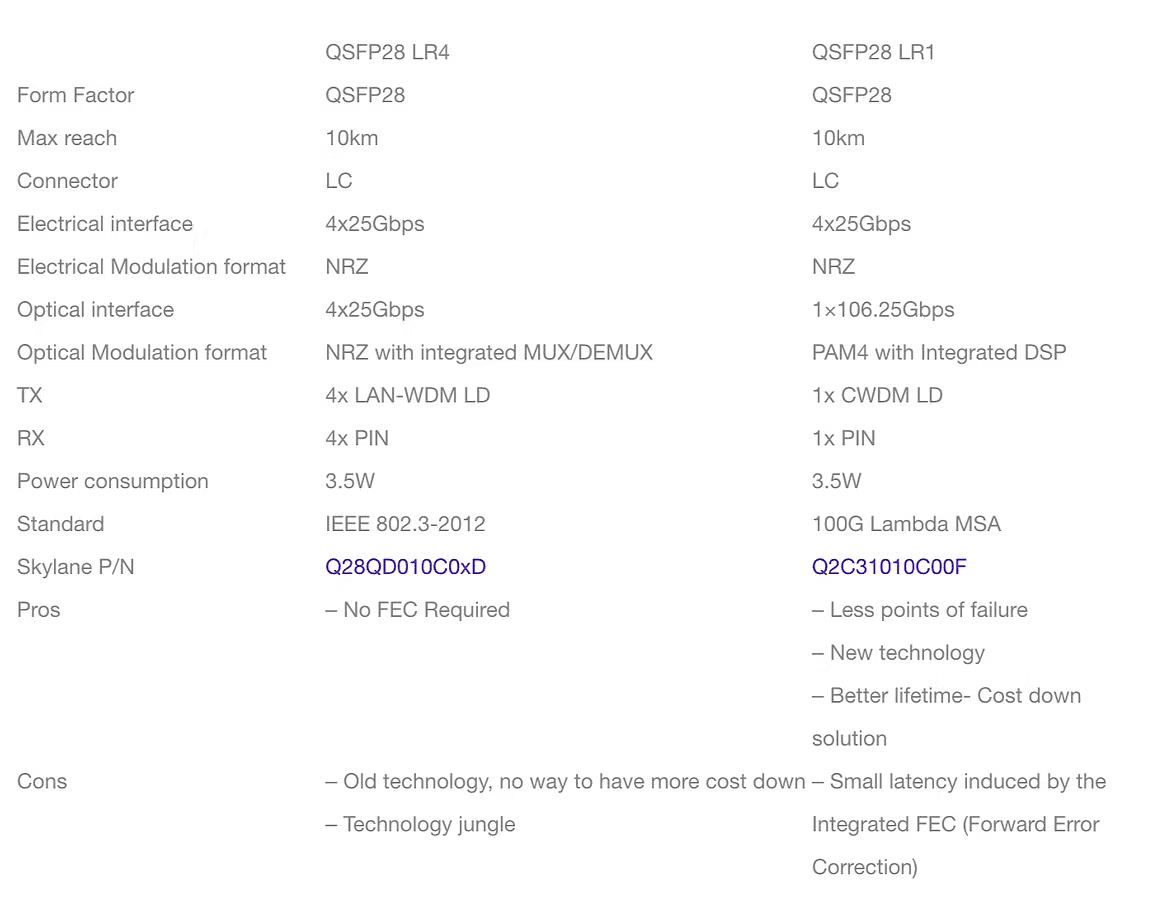
Let’s take as an example the traditional QSFP28 LR4 compared to Single Lambda LR1.
Pros
New technology
Better lifetime
Cost down solution
Cons
Old technology, no way to have more cost down
Technology jungle
Small latency induced by the Integrated FEC (Forward Error Correction)
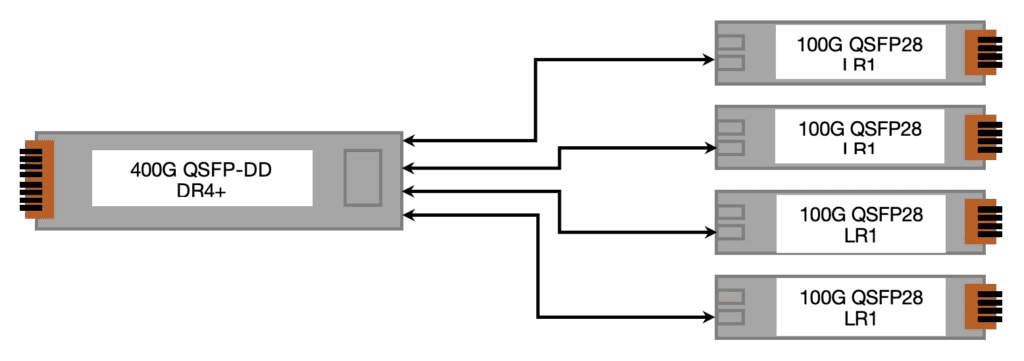
Where does the single lambda attraction come from? Taking into account that a single lambda part can be use in the exact same scenario as a traditional part (point to point), one of the major improvements using them is the datacenter breakout application for 400G links allowing a smooth migration from 100G to 400G connections.
Skylane Single Lambda P/Ns:
Q2C27010C00F : QSFP28, 100GBase-LR1, 10 km, Ethernet, 100GBE, SM, CWDM 1271 nm, 0-70°C, LC, pull-tab, DDM, w/ FEC
Q2C29010C00F: QSFP28, 100GBase-LR1, 10 km, Ethernet, 100GBE, SM, CWDM 1291 nm, 0-70°C, LC, pull-tab, DDM, w/ FEC
Q2C33010C00F: QSFP28, 100GBase-LR1, 10 km, Ethernet, 100GBE, SM, CWDM 1331 nm, 0-70°C, LC, pull-tab, DDM, w/ FEC